
INTERVIEW - TOMAS HELLBERG

For those of you that have been following Parkjets for a while, you will be familiar with our interviews with popular RC airplane designers that have allowed us to host their awesome designs right on our site. It has been a while since we posted an interview and so we thought its time for a fresh one.
We reached out to Tomas Hellberg and he gratiously agreed. Tomas has designed some of the most popular and rock stable designs on Parkjets, including the F-22, F-18, SU-31, SU-37 and more. His designs feature simple build techniques with tabbed construction and profile looks. His unique thrust vectoring tabs allow for excellent acrobatics without a lot of fuss. And we should mention that our prime sponsor, 6mmFlyRC, features many of Tomas' designs as kits, so you can get your hands on a laser cut version. Okay, that's enough of an introduction, let's kick this off....
For those of you that have been following Parkjets for a while, you will be familiar with our interviews with popular RC airplane designers that have allowed us to host their awesome designs right on our site. It has been a while since we posted an interview and so we thought its time for a fresh one.
We reached out to Tomas Hellberg and he gratiously agreed. Tomas has designed some of the most popular and rock stable designs on Parkjets, including the F-22, F-18, SU-31, SU-37 and more. His designs feature simple build techniques with tabbed construction and profile looks. His unique thrust vectoring tabs allow for excellent acrobatics without a lot of fuss. And we should mention that our prime sponsor, 6mmFlyRC, features many of Tomas' designs as kits, so you can get your hands on a laser cut version. Okay, that's enough of an introduction, let's kick this off....
Tomas, can you provide us with a little background with yourself? It's always so interesting to see the designers background and what they do for a living, not to mention the global nature of the hobby!
I am 41 years old and I live in a small village on the country side in Sweden with my wife and three kids. I work as a software engineer for a company that develops safety systems for cars that help to prevent traffic accidents.
I’m somewhat of a gadget geek but my true passion besides RC flight is photography. I also enjoy outdoor life and trekking/hiking.
So you have an engineering background! That makes sense. As you know, you have 6 models on Parkjets right now, but I believe your F-22 is by far the most popular download. Your design of the simple thrust vectoring tabs really changed the way a lot of RC planes were designed, you sacrificed some scale for some really unique performance. Can you take us through your design process and some of the inspiration for your models?
It all started when I saw a video of someone flying the Ikarus Su-27 on YouTube. The Ikarus model is a simple profile pusher jet that uses tabs and slots to help the builder align the parts. I thought to myself “I can build something like that”. So I began working on the F-22.
I chose Google Sketchup for designing my model as it was free and I already had some experience with it. I found some three-view diagrams on the Internet and started outlining the wing and the fuselage. When I finished the outline I put the parts together in space to form the actual aircraft. Then followed the process of creating slots and tabs to help with alignment during assembling. And that is basically the design process I’ve used with all my designs.

We have seen lots of designers are using Google Sketch Up. It's a great tool. And we like the "maker" attitude you brought to the table. Many hobbyists have the same experience, we see something and believe we can make it. Okay, out of all your designs, which model do you prefer to fly or which model are you most proud of, you get the idea?
I’d say the F-22. It looks great and has a great flight envelope handling both high and slow speeds really well.
The F-22 is one of the favorites in our hanger too. That and your F-18E.
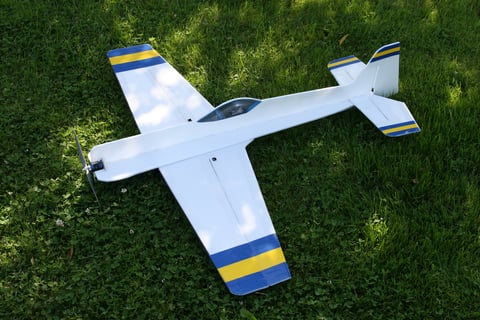
One design we recently added is your SU-31. I have to say it’s a great, simple design that has a lot of versatility. Do you have any advice for those pilots looking to build and fly your SU-31 for the first time?
Make sure your servos are glued properly. :-) I crashed mine on one of the first flights when one of the servos came off during a dive. Other than that I don’t have any particular advice for the Su-31.
I designed the Su-31 mainly because I wanted a less noisy plane to fly. Most of my other designs are of the “prop-in-the-slot” type, which are really loud.
Servo failure. What can we say, it happens. Great tip though. And the SU-31 remains a popular download each month. Not including the SU-31, all of your jet designs feature a mid-fuse engine design. What was your primary reason for going with a mid-engine design?
It’s mainly about center of gravity. With the engine mid-fuse I can have the electronics farther back. For the F-22 and Mig-29, this means having the electronics inside the main fuselage compartment.
The mid-fuse placement of the engine also means that there will be a direct airstream from the propeller over the rear control surfaces which increases the plane’s agility. This is in a way like the thrust vectoring nozzles of the real F-22. The tabs on the elevator increases this effect, at least in theory.

Based on performance, we would guess you can put that theory in the "confirmed" catagory. We can tell you that your designs are downloaded from all across the globe and that has to be rewarding to know that your designs are flying in just about every place around the world. What would you say makes your designs appealing to such a large audience?
First of all, my plans are free, so that is important. Other than that it’s probably the fact that the depron airframe is cheap to build and often quite easy to repair. And perhaps that my designs can be assembled rather quickly.
Also perhaps the fact that at the time when I first published the F-22 and the Mig-29 there weren’t that many good free plans available for pusher profile jets.
With a family and work, do you find the time to get out and fly anymore or design anymore?
I don’t find the time to design at the moment. I do try to make time to get out and fly now and again. My latest passion is flying DLGs, or discus launched gliders. There’s something special with flying a glider with no motor. Here I am flying the ELF DLG from Vladimir’s Model.
Gliding is considered the purest form of flight by many and we know lots of people have modified your F-22 by increasing the wings to turn them into gliders!

Do you think you will design anymore RC airplanes in the future? I know a lot of people have been inspired by your designs but having you crank out another would certainly be well received in the RC Community.
At the moment there are so many other things in my life that I just don’t have the time required for doing new designs. But I’m pretty sure that I’ll get back into designing at some point. I just don’t know when.
Well, when you get around to it, Parkjets would love to host it! I'm sure it would be an instant hit.
One of the cool modifications we have seen to your designs is that people are using Electric Ducted Fans instead of the propeller and simply mounting it in the same place. Some of these EDF’s are getting pretty good performance because your design is very light weight. Do you have any experience or advice for builders wanting to modify your design for EDF?
I’ve been wanting to get into EDFs, but I haven’t gotten around to it yet. So, no, not really. But I’m following the development with interest.
EDF's are finally getting good, but we have to admit, we like a good pusher as much as anything. We don't want to take up too much time, is there anything else you want to add? Tips? Advise for new builders? Etc?
I’ll leave you with this tip: More or less any design with enough wing surface will fly as long as you get the center of gravity right. It might not have superb handling, but it will fly. So don’t be afraid to experiment.
Thank you so much for taking the time to answer our questions Tomas! It was a real pleaure and gives our readers some insight into your designs and your life. We can't thank you enough!
That's all folks, if you want to check out Tomas Hellberg's designs right here on Parkjets, you can sort by designer and of course you can visit his website for great pictures, manuals, and of course, you have the opportunity to donate directly to him from Parkjets too. And if you are not wanting to cut out your airframe, visit 6mmFlyRC and get a laser cut kit shipped to your door.
INTERVIEW - CHRIS CARPENTER
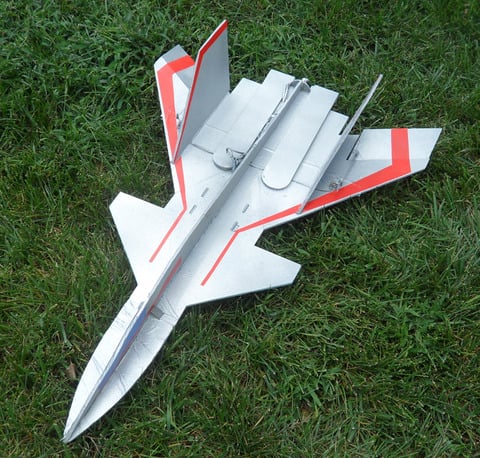 F-95 Morningstar
It's been a while since we posted an interview with a designer or company here on Parkjets, so to kick off the new year, we thought you might like to hear from a designer that is running a business! It's like a two for one. We reached out to Chris Carpenter, designer of the MIG 31 "Firefox" and the F-95 "Morningstar," and he is the guy on the other end of the line when you contact RCProfilePlanes.com. He recently sent over the plans for the Morningstar and we asked him a few questions. So without boring introductions, let's get started with the interview!
F-95 Morningstar
It's been a while since we posted an interview with a designer or company here on Parkjets, so to kick off the new year, we thought you might like to hear from a designer that is running a business! It's like a two for one. We reached out to Chris Carpenter, designer of the MIG 31 "Firefox" and the F-95 "Morningstar," and he is the guy on the other end of the line when you contact RCProfilePlanes.com. He recently sent over the plans for the Morningstar and we asked him a few questions. So without boring introductions, let's get started with the interview!
Alright, first of all, thanks for taking some time to actually do this interview. We really appreciate it. Let's kick this thing off right and why don't you tell us about yourself. Where you live, work, how long you have been in the hobby, how long you have been designing, all that good stuff?
My name is Chris Carpenter. I live in Laurel MD and I work in Information Security for the Federal Government. I’ve been flying RC airplanes for about 13 years. I have been designing planes for about seven years. I remember staring at the Sear catalog as a kid (before they discontinued it….) and dreaming of having my own RC Plane. I’m blown away these days by how cheap and easy it is to get into the hobby. It’s a wonderful time to be a RC pilot.
You are right on that point, the cost to enter the hobby has never been lower. So far, it looks like you have about half a dozen designs out there, mostly focusing on modern jets, much like Parkjets. But we have to ask, do you have a favorite?
My favorite plane is the MIG-31 Firefox. It’s from the movie of the same name (Firefox). The movie is horrible except for the plane. I was in love with that jet from the moment I saw it. The Firefox I designed looks great in the air. The design is really clean and it’s pretty fast. I was also surprised how well it slows down and how easy to land it is. It just looks mean up in the air. The Firefox is also the most popular plane I sell as well. I think it’s the most popular for the same reasons. It flies great, looks really mean in the air and it also goes together very easy. I think there is a lot of sentimentality for this plane. It’s just a piece of 1980s nostalgia that I think a lot people can relate to. I remember flying it at Fun Fly at my local airfield and being asked, “What plane is that?” When I answered the announcer got on the mike and said, “Hey! Clint Eastwood wants his plane back!”. It was pretty funny.
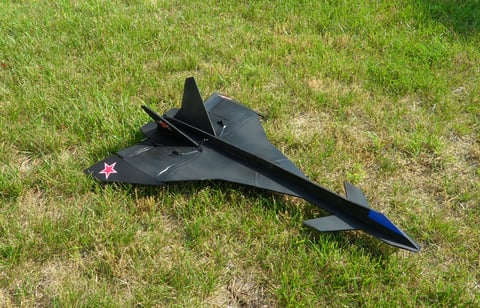 MIG 31 Firefox
You know, it's funny, that movie, well just about everyone has seen it. I'm not sure if it is just because Clint Eastwood was such a star back then or if it was the cold war backdrop to the plot. Who could forget the rear-firing missiles? I guess it's no surprise that it's the most popular kit on your website.
Shifting gears a little to the nuts and bolts of building, many modelers are using Depron foam, it's been the standard for years. Is that what you prefer to work with or do you use a different material?
I started out building with Bluecore foam and it’s my preferred medium. Depron is nicer and sands better but the higher cost just makes it impractical for me. I can’t find the original Bluecore locally anymore but I can get Dow Protection Board III which is very similar. For profile plane like I build it works out great. If you take the protective film off it still sands well. You can use Balspar paints from Lowes to paint it without melting as well.
Nothing wrong with Bluecore, but it is getting difficult to find these days, and when we find it, its usually damaged or cracked from poor handling. So we know what you like to use when you build, but what do you like to use, what modeling software do you prefer when you design?
I design all my planes in Sketchup for a couple of reasons. One, it was pretty easy to learn and two the PhlatScript plugin. PhlatBoyz created the PhlatScript plugin for Sketchup and it makes it simple to export Sketchup designs to G-Code for the CNC machine. There are probably better programs out there but the learning curve was for Sketchup was really short and so far it has met my needs.
I think most people use Google Sketchup for the exact reasons you state, it's a good-enough product that has a price tag of zero. Can't beat that. What about someone that wanted to design a plane for the first time, what is the number one thing they need to do first?
It really depends on the subject your modeling and what you want out of the model. For me the first thing is to find a good 3 view drawing of the plane. Google is your friend. A lot of times a simple search for the plane and “3 view” yields a great drawing. You can refine your search for large images and you are in business. After I find a good drawing or images I decide how much detail is realistic for the amount of effort I am willing to put in. I know some people are super scale detail enthusiasts but I go more for instant gratification. So, I usually look at the three view and figure out how it will look as a profile plane. You can then import the image into Sketchup and start to trace the outline. There are a ton of videos on Youtube that walk through the process. That’s how I learned how to do it. For me the trick is how much detail can you add in while still using a profile? If you look at the star wars miniatures games from Wiz Kids you can see some awesome examples of profile Star Wars ship that look pretty realistic.
Those are great tips. We hear all the time that the full fuse planes look great on the ground and great in the air too, but a profile plane, when in the air, looks just about as good. Certainly for the time and effort, they look great too. One benefit we have found in simple profile planes is the ease of flight, would you say your kits are for the beginner RC pilot or are they for the more experienced pilot?
I would say my kits are for the intermediated pilot. Primarily, because with the recommended setup my planes are pretty fast. My planes fly well over a wide speed envelope. The fact that they are delta wings also adds to the stability. However, for a brand new pilot it would be to easy to one of my planes going full speed and crash. The flip side of that is that because of the low cost of the kits you don’t need to be super paranoid about crashing your plane because you don’t have a lot of money in the air.
You hit the nail on the head. These foam planes are so cheap to replace and repair that once you get over that initial cost of getting your radio and some power gear, the airframe is literally cheaper than a happy meal. It's incredible.
I want to shift gears again and talk about your business. A lot of RC guys dabble and think about carving out a little niche for themselves with designs and a little kit business. What made you decide to open up an online RC business? Were you inspired by anyone or any business?
All hail Steve Shumate! That man is my inspiration! His designs have brought me more joy than I can describe. I love SGTalon’s stuff as well. I realized I was spending a lot of time designing and building so I figured, why not have a go at selling my work. My other goal was to raise enough money from planes to fund my hobby and buy new planes.
The biggest issue for me was keeping production costs down and how to produce quality kits quickly. I had been thinking about a CNC machine for a couple of years but most of the machines at the size I needed were way out of my price range. Doing some research on cnczone.com led me to go a small business just north of Baltimore. He custom designed a machine that met my needs and it was very reasonably priced. I decided to use Bluecore foam to keep costs down. Actually, the hardest thing for me to find was reasonably priced boxes to ship my product.
I wanted to keep the parts count down and that meant the kit parts would be larger so I needed bigger boxes. You’d be surprised how hard it is to find large thin boxes readymade. Again, I found a local retailer that sold what I needed. At that point I just needed to design the planes. I had four designs in mind and I wanted to have them all ready before I opened.
The interesting thing for me is what you do to make a repeatable process that a customer can follow versus what you do on your own putting a plane together. It was interesting to note all of the little things I did to make a plane go together and how make sure the kit either incorporated it or the instructions covered. So I ended up building each plane three or four times. Lastly, I needed to get photos and video. I finally settled on a hat mounted HD key chain camera to make my videos. I shot stills of the painted planes and I was ready to load it up into the site.
I chose to use WordPress for my site because you could get out of the box, ready to sell websites. I loaded up my products and I was online. I also listed my products on E-bay. I’ve been in business for about a year and half and it’s been a blast.
You know, you talked about some challenges that no one else has mentioned. Boxes, software for the CNC, using Sketchup plugins, creating a repeatable product via instructions, and the challenge of getting some decent video of your products. Those are all things that everyone needs to check out before getting into a business. That is just some excellent insight for our readers. Just based on your business name (RCProfilePlanes.com) it looks like you are focused on profile plane designs. Why do you focus on the profile design?
I do profile planes for ease of construction and ease of flying anxiety. I learned how to fly on a Multiplex Space Scooter. I beat that thing to death before I learned how to fly. After that I found rcgroups.com and all of the plans available there. I immediately fell in love with pusher prop jets. I realized you could cut, build and fly a profile plane in a day. Even if you nosed it in (I never do that…) you just cut some more foam, throw the electronics back in, and away you go again. I learned to fly pretty well because I had no fear of crashing with profile planes. The other thing I came to realize is that while a full scale model looks great on the ground its hard to tell the difference between a profile and full fuselage plane in the air. The lower cost and lower fear factor always send me back to the profile planes.
Additionally, it’s really cheap to overpower a profile plane. You can get a $30 power setup that will give a 2:1 thrust ratio. With that type of power you can get yourself out of all sorts of trouble ;-). With the right paint they usually look pretty scale as well.
Who doesn't love to add on power! A great advantage of the lighter planes is cranking up that thrust to weight ratio. Excellent point. You already touched on a lot for our readers wanting to start a business, but do you have any advice for them? Is there one tip or bit of advice you might offer?
Honestly, if you want to do it’s just a matter sticking to it. If you have the ideas the technology is there. You can cut your own kits or contract someone else to cut them. Either way, I feel the biggest requirement is to have the ideas and vision.
And that success probably won't happen overnight. If you love doing it, it helps a lot. One thing we noticed that is that you offer kits but you also offer the free download of the plans right on your website, the same ones you allowed us to post on Parkjets. Why do you do that? It seems like giving away the plans might hurt your kit business. Don't get us wrong, we love it (coming from a site that offers over 115 free plans).
RCGroups.com is an awesome community. I have download many, many plans and gotten a lot of enjoyment out of it. Most people freely provide their plans and just didn’t seem right not to give back to the community. Let’s be honest, it’s also advertising for your business. You offer the free plans and you provide a link to your kits.
The people who are going to build on their own are going to do that. For some though, it comes down to what is your time worth. Those people are likely to buy a kit. So, I don’t think I loose anything in giving the plans away.
The folks at 6mmFlyRC have the same thoughts. The RC community is an incredible (and international) group of folks. Obviously we think there is great value in building your own RC airplane, but we have seen over the last 10 years a move to the "ready to fly" models. Do you have any thoughts on building vs. buying your RC plane?
I like both. It’s easy to walk into a hobby store, see that beautiful boxed plane, buy it and fly it the same day! I got a Stryker for an anniversary present and that was total instant gratification!! However, there is something really special about building your own plane. It’s just an awesome sense of pride you get from doing it. For anyone that has not tried it, I highly recommend it. There is just a greater sense of accomplishment and ownership. For a first kit build, you can’t beat a profile plane. It’s faster, easier and really cuts down on the fear of that first flight.
We couldn't agree more, building for us, beats buying any day. Well, Chris, we have taken up probably way too much of your time with this interview, do you have anything else you want to add?
I would just like to add that I really love the hobby and RC flying in general. Even if I don’t sell kits I still get to fly the planes I produce. The money from selling is a bonus ;-) If anyone is on the fence about designing, building or selling, get off it. It’s a blast. Also, I try to design planes that are different. You can find a ton of models for F-15s, F-16s or the F-22. Try to find the T-50 Golden Eagle and it’s a different story. Even worse try to find a Sci-Fi kit and it gets really scarce. So I try to build the unique and the obscure.
We have been trying to add more and more Sci-Fi models over the last few months and your "Morningstar" is a real winner. Wow, we can't thank you enough for all your time and your openess with how you started and the challenges of designing using CAD and cranking out kits for sale. Thank you. Thank you. Thank you.
We encourage you, our readers, to visit his website and pick up a kit or two or three. The price is right and you will save yourself a lot of time, precious minutes you can be at the flying field.
That wraps up the interview with Chris Carpenter of RCProfilePlanes.com. Hope you enjoy and please add your comments or questions in the comment section.
INTERVIEW ROUNDUP
One of the more popular resources on Parkjets is the various interviews we have conducted designer and companies in the RC Community. A lot of people enjoy reading the interviews for idea and inspiration for their next build. We thought it might be a good idea to do an “interview roundup” and pull out some of the best tidbits from each interview, link them all and create an easy resource for you to go to time and time again. And since we are reaching out to designers and members of the RC Community all the time, this is one resource that will continue to grow, just like the number of free downloads in our catalog.
If you have never taken a few minutes and actually read through these interviews, there is almost something for everyone, so get a cup of coffee or something and read over a few.
One of the more popular resources on Parkjets is the various interviews we have conducted with designers and companies in the RC Community. A lot of people enjoy reading the interviews for ideas and inspiration for their next build. We thought it might be a good idea to do an “interview roundup” and pull out some of the best tidbits from each interview, link them all, and create an easy resource for you to go to time and time again. And since we are reaching out to designers and members of the RC Community all the time, this is one resource that will continue to grow, just like the number of free downloads in our catalog.
If you have never taken a few minutes and actually read through these interviews, there is almost something for everyone, so get a cup of coffee or something and read over a few.
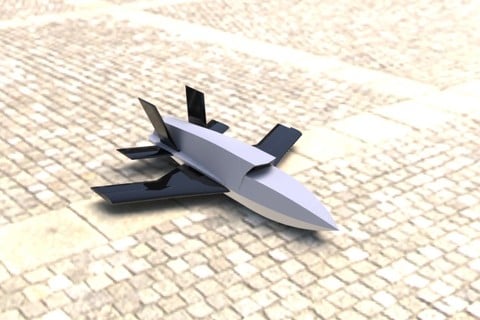
Interview: Sabastian Gulde, Designer of the EADS Barracuda | Advise on achieving beveled cuts on EPP foam: “I did build a hot wire cutter, however I noticed later that a utility knife and sanding paper works just as well if you take your time and mark the cutting line before. It is best to first cut out the part straight, and in a second step do the beveled cut.”
Interview: 6mmFlyRC – Company and Sponsor of Parkjets.com | On lessons learned running your own RC business: “This won't be that popular to say but honestly the number one lesson we learned is that just because you have some people asking for a product, it doesn't mean it will sell. In some ways, it’s totally unpredictable.”

Interview: Jamie Rothwell, Designer of the Alpha Jet and more | On the Alpha Jets incredible high alpha capability: “The incredible high alpha is achieved because the leading edge of the top wing is slightly in front of the leading edge of the bottom wing. So when the plane is in high alpha, the top wing is scooping the air over the bottom wing and the propeller is also pulling air through the air intakes, which are in the middle of both wings.”
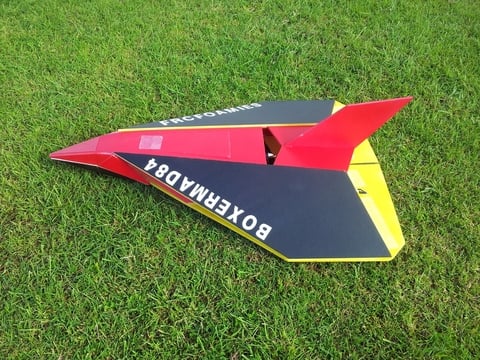
Interview: Nico Hobbies – Company and designer | Advise on purchasing an expensive brand name motor over cheaper models: “Personally, I see no reason why someone would need to purchase a Hacker or E-Flite brand motor just for better reliability, as I've had almost no issues with the cheaper brands.”
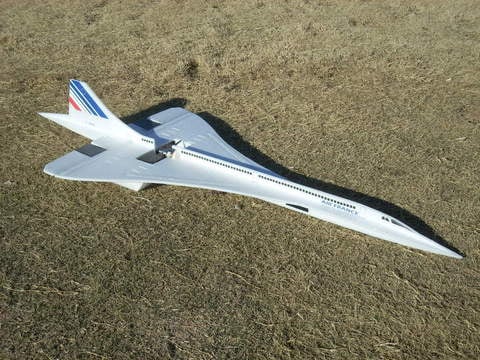
Interview: Steve Shumate – Designer | Advise to hobbyists: “The only thing I'd add is to encourage guys who are used to flying RTFs to try building a foam model from scratch or from a kit. The sense of satisfaction you'll get from the end result will probably give you a whole new appreciation for this great hobby.”
src="http://pagead2.googlesyndication.com/pagead/show_ads.js">
STEVE SHUMATE - INTERVIEW

Frequent visitors to Parkjets probably already knows the name Steve Shumate. His designs have been featured in multiple print magazines and continue to be very popular on Parkjets. Some even call him the "godfather of parkjets." Since Steve's designs are by far the most popular download on our site and since we started this interview series, we figured we would shoot him an E-mail. Well, we reached out to Steve and asked if he would be willing do a small interview with Parkjets and he agreed! So sit back and enjoy a little insight from one of the best designers of RC Parkflyers out there...Steve Shumate.
Steve, although we always think everyone knows your name is synonymous with parkjet designs, a lot of our readers are brand new to the RC hobby. Can you give us just a little background information?
Sure. I've been flying RC for 30 years now. I built my first RC airplane back when I was a teenager and taught myself how to fly (it was a 2-meter sailplane, so wasn't too hard). I've been an airplane nut my whole life, and built plastic models, free flight models, and control line models before graduating up to RC. I got my full scale pilot license when I was 18, and then went to college and earned a degree in Aerospace Engineering. I was hired by the Boeing Company right after graduating, where I still work today. I've been lucky enough to spend my whole career in Product Development at Boeing, and helped design many Boeing jets that never got built (600-seat double deckers, new versions of the 747, Sonic Cruiser), and a few that did (777-300ER, 787). I worked on the 787 from Day 0 on the program and am still working on the 787 today. My current job is in Product Strategy, where I help figure out what new versions of the 787 Boeing should develop in the future.
That's an amazing career so far. Being able to do what you love and all at a company that is on the front line in passenger flight on a global scale.
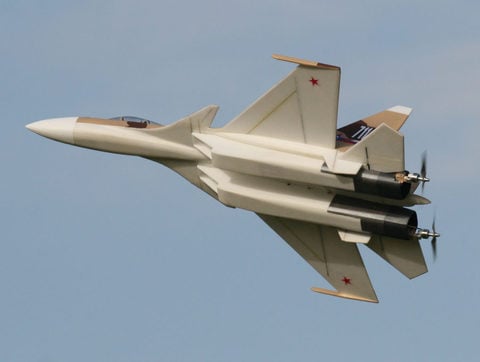 Steve Shumate SU-37
I'm sure a lot of our readers are envious of all the really awesome projects you have had a hand in shaping. With such a heavy workload and family, do you manage to get out and fly anymore?
A little, but not a lot. I've got two small kids at home, and family takes up much of my free time these days. I'm sure I'll get back into the hobby more once they're older.
That's understandable. When you have a few kids, your priorities shift and we see it all they time in hobbyists. Many visitors to Parkjets have been out the hobby for 20 years and then get the itch again.
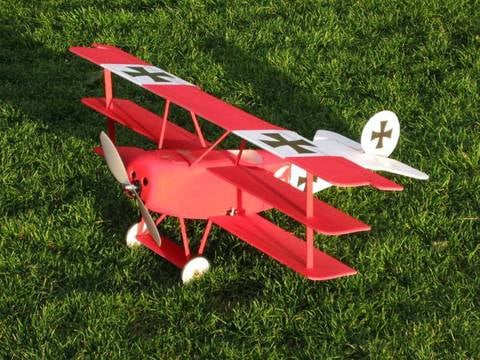 Fokker DR1
Even though the hobby has taken a little bit of a back seat for you...you've been pretty active on the RC forums out there, and we haven’t seen any designs out of your shop in a while. Do you have any desire to get behind the CAD software and begin designing again? We know if you did, the buzz around whatever you designed would be tremendous. In some ways it would be like long awaited sequel to a blockbuster movie.
I DEFINITELY have the desire to design new airplanes, but just don't have much free time right now. That said, I always have a project or two on the back burner that I like to tinker with when I get the time. Can't let my CAD skills get too rusty!
We will get our popcorn ready when you give us the word! The nutty thing about CAD software is that it is getting easier and more consumer friendly all the time. The Google Sketch Up product is a fantastic example of some consumer friendly software. But we know what you mean, with the rapidly changing world of software, it's easy to get rusty. We hope you decide to knock the rust off soon!
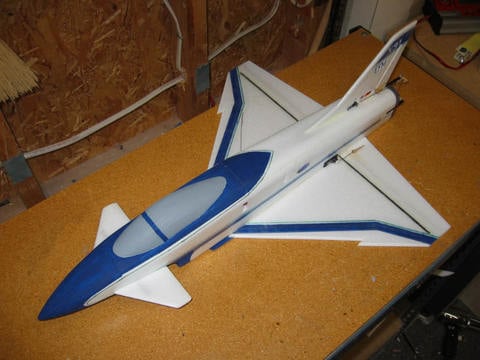 Steve Shumate X-31 EDF
One of the great things about your designs is that so many others have taken them and modified them a little with the help of CAD. Are you surprised that your designs really sparked so many other hobbyists to take their ideas and put them down on paper (or CAD)? It just seems like your designs shifted so many people’s thought process in terms of using a new material like depron foam to create scale models that performed well and look great.
Yes, I'm continually amazed at how popular some of my designs have become, and feel quite honored. I certainly didn't invent parkjets or Depron scale models, I just borrowed some good ideas from others before me and integrated them together. To me, much of the credit for how popular my designs have become goes to RC Groups, which makes it so easy for folks to share their work and discuss it with others. It's where I learned most of what I know about foam RC models, and where I've then shared my new ideas. And of course other RC forums from around the world link to and borrow stuff from RC Groups, expanding the influence.
We have to say that we have spent our fare share of time browsing RC Groups, reading through the mountains of threads and questions. It's one of the best resources out there.
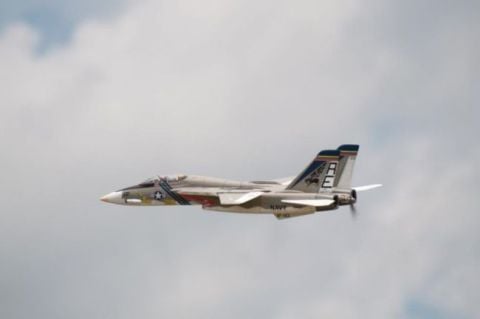 Steve Shumate F-14 TomcatYour designs continue to be very popular on Parkjets, and we know they are flying all across the world. In the fast evolving world of RC Airplanes, your designs have stood the test of time. Why do you think your designs have had such lasting power?
I think a key reason is the balance they strike between being quick building vs. semi-scale. True scale models tend to be complicated to build and challenging to fly, yet quick-building flat foam models fly great but tend to not look very scale. So I've tried to find a good balance between those two competing design goals in all my designs. I'm also not afraid to deviate slightly from scale to improve flying qualities, things like enlarging tails for more stability or making small wing planform changes to reduce tip stall. Nearly all of my designs have tails that enlarged about 10-20% from scale, for example. Scale looks are important, but not as important as buildability or flyability in my book!
As any RC pilot can attest, crashing a scale plane feels no different than one that has a slightly larger tail. Flyabilty is absolutly key. I'm sure you know that your F-14 and F-22 are very popular designs and continue to be some of the most downloaded plans on our site.
In fact, last month, out of the top 10 designs downloaded, you had four (SU-37, F-14, Super Bandit, and F-22). But just down the list is a design that doesn't get a lot of discussion, the Boeing Sonic Cruiser. We know you have a personal connection to the design, can you just briefly tell us about your personal connection?
Yes, I was the Configuration Design lead for the Sonic Cruiser. I was responsible for integrating the aerodynamics, structures, and payloads elements, and then developing the overall design of the airplane. It was one of the most fun times of my career! The Sonic Cruiser broke new ground in many areas, and was an airplane engineer's dream to work on. Lots of design challenges looking for innovative solutions. But as you probably know, the market eventually shifted toward fuel efficiency over speed, so Boeing ended up putting much of that new technology into a slower airplane that eventually became the 787. So once the Sonic Cruiser project was cancelled, all of the engineers like me simply transitioned over to the 787.
The Sonic Cruiser is by far your simplest design, especially when compared to say your SU-37. The Sonic Cruiser is really just a profile type parkjet with twin power and working canards, which makes it very unique.
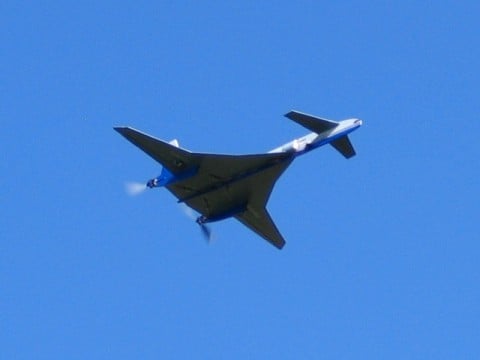 Steve Shumate Boeing Sonic Cruiser
Do you have any advise for builders out there wanting to build the Sonic Cruiser?
It took two prototypes to get a Sonic Cruiser model that flew well, but the final design is really a pussycat in the air and easy to fly. The key advice I can give is to be careful to ensure the two motors are perfectly matched, which is standard advice on twin-engine models. Also make sure to keep the weight down.
The Sonic Cruiser looks so good in the air. We sure wish the real thing was built and flying! Another popular design is your SU-37. By far this is the most impressive model we have seen, just in terms of pulling it out at the flying field. It always get a lot of attention. But what design are you most proud of? I mean, everyone loves the F-22, but even your Fokker DR1 is a very cool design too.
I'd say the Su-37 is the design I'm second-most proud of. The first has to be the F-14. It took a lot of hours behind CAD to figure how to make that model easy to build yet scale-looking and good flying. The wing swing mechanism was an especially challenging part of that design. I also had to make some tough calls on the scaleness of the model, such as losing the characteristic canted engine inlets to greatly simplify construction. But the best part was the prototype flew perfect from the first flight on, no design modifications were needed. That said, if you ask which of my designs that I personally fly the most, it would be the Fokker DR1. It's simply a blast to fly that model. I love how it can be flown slow and scale-like one minute, and then do harriers and hovering the next. Plus it requires only the smallest of flying fields, so I can fly it anywhere.
Love the Fokker. It's so stable in flight and a great change of pace from the jet designs. But you are probably right, the F-14 has such an impact with the swing wings, a real engineering victory!
What continues to amaze us at Parkjets is that so many of our users are first time builders. With all the out of the box (RTF) models coming out every week, we just can’t believe there are so many out there that still want to get their hands dirty, create their own model. There is a certain satisfaction, we think, to starting with an empty work bench and completing a project. And for you, the satisfaction must be 100 fold, given that you know that thousands and thousands of modelers have taken your designs and had so much fun. Why do you think there is this base desire for modelers to keep building?
I agree 100%--nothing compares to the feeling of starting with a few flat sheets of foam on your work bench and then turning them into a great flying and scale-looking model airplane. RTFs can't begin to compete with that level of satisfaction in my book. And yes, I'm especially thrilled that my work has encouraged others to try their hand at building from scratch rather than just owning RTFs. RTFs have their place and I certainly own a few, but I don't feel anywhere near the connection with those models as I do with the ones I built myself.
It's funny you say that, because in some ways a scratch built RC airplane is like an old car. You just get connected to those models that you have a hand in building and creating. Like that old car that you have replaced a few parts on, kept it going over the years, and talk in to starting on a cold morning. It's very satisfying!
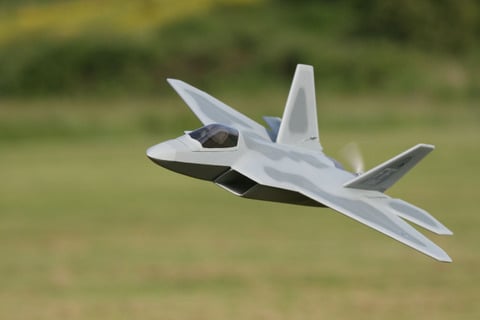 Steve Shumate F-22 Raptor
Over the last few years, we have seen a rapid expansion of EDF, and we get asked this all the time, "How can I adapt an EDF set up to one of the Steve Shumate models?" Do you have any advise for builders wanting to convert your plans to EDF?
Yes, many of my designs lend themselves quite well to EDF conversion--and many of my later designs I specifically designed with that in mind. However, EDFs aren't easy to get to work well. To have a good-flying EDF, the power system (fan diameter, motor, battery) must be precisely matched to the airframe (wing sizing, weight, inlet area, exhaust area. If you just plunk a fan unit into a model (including my park jets), the chances of success are minimal. At minimum you've got to pick the right size power system and verify or modify the airframe design to provide the proper inlet and exhaust sizing. I've designed two EDF models (Super Bandit, X-31), and was surprised at how much design work it took to match the airframe to the intended power system. But that work paid off, as both flew very well.
EDF is something we have dabbled in and it seems now, the power systems are getting to the point where the EDF can do pretty well in the air. We like to stick to the larger fans, but your X-31 design flies so well, and with the thrust vectoring, it's truely an amazing plane. We don't want to take up too much of your time, but do you have anything else you want to add? One thing we try to stress out there to our users is that the various designers deserve a little donation, which they can do on every page.
The only thing I'd add is to encourage guys who are used to flying RTFs to try building a foam model from scratch or from a kit. The sense of satisfaction you'll get from the end result will probably give you a whole new appreciation for this great hobby.
That's great advice Steve. Thank you so much for taking the time to crank out this interview. We know our readers will love all the great things we have gone over. Good luck to you and your family! Blue Skies!
There you have it folks! Be sure to check out all of Steve's great designs and for those of you wanting to cut out a little build time, our site sponsor, 6mmFlyRC, has some great kits of a lot of Steve's designs. They also have stand alone products like clear canopies and decals available for you if you want to cut out your own.
INTERVIEW - NICO HOBBIES
For those of you that have been on Parkjets for very long, you have probably seen some of the great designs from the designer of Nico Hobbies, Pat Gagnon. We thought we would continue our series of interviews by brining in Pat to answer a few questions about his business, his designs and over all his contribution to the RC community.
First off, thanks for doing this interview with us Pat. We added in some of your designs about a year ago and they are popular spots for many builders. But before we get into any specific questions, why don't you tell us about yourself and about your business?
I dabbled in RC back in the 80's as a teenager, but back then it was a lot harder to get into it with the initial expense for a radio and flight gear, so I didn't stick with it for very long. But at Christmas 2005, I walked into a HobbyTown USA and purchased a Parkzone Firebird Commander II, and was reaquainted with the joys of RC again. And it's been a wild ride ever since!
We knew you had lots of experience but your story is not uncommon, people get into it, drop out for a while then return with renewed passion! That's fantasitic. Many of your designs are featured on Parkjets and are popular downloads, why do you think your plans and kits are popular?
Pusher Jets have been a popular design style for many many years. Around 2004 or 2005, a gentleman by the name of Steve Shumate (many of his plans are featured here as well) started drawing up easy-to-build planes using flat foam and a geared GWS power system. Soon after that came the advent of brushless motors, lithium batteries and depron foam, and the Pusher Jet craze really took off! The Pusher Jet design style is perfect for those who want a jet model, but not the hassle of an EDF power system.
You mentioned some of the advances in technology, for example the move from brushed motors to brushless and the cascade of changes that followed are pretty amazing. Have you found an ideal set up for your models?
The main series of kits I have right now is the Profile Mini Series. These are small ~18" wingspan models that have an AUW of 6-7 ounces. The perfect setup for these planes is the AX-1806N 2500kv motor paired with a 10A ESC and a GWS 4530 prop, using a Hyperion G3 3S 850mAh 25C lipo. This system will provide about 11 ounces of thrust, and will provide unlimited vertical performance on most of my kits. Two other series of planes that will soon be offered are the Pocket Jet Series (reduced versions of Steve Shumate's full-bodied jets, produced under license) and the Simple Build Series. The Pocket Jets will also use the same power system as the Profile MIni planes. The Simple Build Series is larger profile planes that have a wingspan of ~28", just like a lot of other popular designs from folks like Tomas Hellberg and Nick Cara. These planes use a Suppo 2212-6 2200kv motor paired with a 30A ESC and an APC 6X4E prop, using a Hyperion G3 3S 1300mAh 25C lipo. This system will provide about 24 ounces of thrust, and will also give unlimited vertical performance as the Simple Builds will be 13-18 ounces AUW.
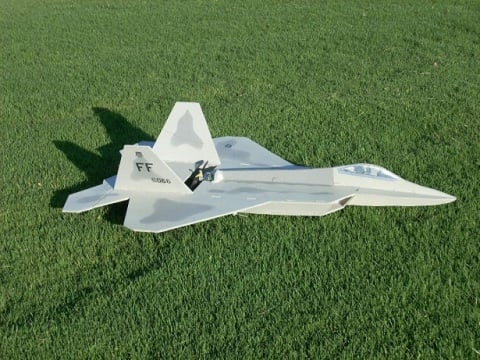 Mini F-22
That's outstanding. A simple set up that doesn't cost too much money. For most of the builders out there, a very important thing to consider is the price of the equipment. In fact, we kind of touched on the issue with our "Buy or Build" post a few months ago. With all the changes in motors and the rising and falling prices, what are your thoughts regarding using a less expensive motor vs. a high quality motor that might cost twice as much? Is it worth it for most RC pilots?
This has been an argument on the scale of electric vs gas that has gone on for quite some time. It all really depends on the motor manufacturer. So far I have only found two manufacturers of the 2212-6 motor (Suppo and Welgard), and only one company producing the AX-1806N motor, even though these motors are distributed by many dealers with their own brand name. I've had better luck with the Suppo brand than the Welgard, and nothing but good things to say about the AX-1806N. The problem with motor selection for these pusher jets is that there are not many choices because of the high kv rating required. Many guys also use heli motors in these applications. Personally, I see no reason why someone would need to purchase a Hacker or E-Flite brand motor just for better reliability, as I've had almost no issues with the cheaper brands.
We tend to agree, we have never had an issue with many of the cheaper motors. But your perspective on gas motors vs. electric is a great point. At the beginning, electric was so expensive. I can remember when batteries were $60 a piece. Now you can get them for $10. And the same goes for motors and speed controllers. Electric RC flight really is affordable. Let's shift gears a little bit, with all your different designs do you have a favorite?
Yes, I do, and it's the Mini Profile F-22 Raptor. That is the most stable, but also most aerobatic plane that I sell. It is also my best selling plane to date. In fact, every time I attend a show where I have a booth set up, I build several RX-ready F-22s and sell out of them every time! A close second would be the Su-30MK Flanker-C as it is very similar in performance to the F-22.
One thing that makes your designs a little unique is the size. Most of your designs are smaller, much easier to transport, especially for a quick run to the park. What are the benefits and drawbacks of a smaller airframe?
Surprisingly, you can fit several of these smaller planes into your trunk or back seat. And since they are so small, you can fly them just about anywhere. I have an F-22 that has 168 LEDs on it, and I often walk out my front door and fly it around my neighborhhod at night. And as small and light as these are, you'd think they would not handle wind very well, but I have flown some of them in winds of 15mph steady, and gusts to 25mph without problem. In fact, I have more fun flying them when there is a bit of wind. The only drawback would be for the newer flyer, or some of our more aged pilots. These planes are quite zippy at full throttle and can literally turn on a dime. You have to be able to keep up with it if you want to fly fast. However, they all slow down real nice, and most of them high-alpha hover really well, especially with a breeze blowing.
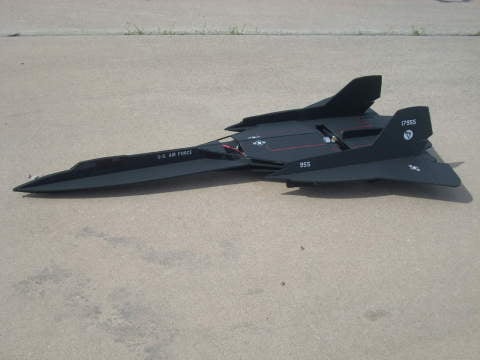 SR-71
SR-71
I really like the idea of the LED's! That really says a lot about your designs that you can squeeze in a flight right in your neighborhood. One question we get all the time from folks is about glue and foams. It seems like there are new adhesives and new foams out there all the time, do you have any recommendations for foam and glue for the builders out there?
I strictly use white depron. I have a friend here in Mesa (Jim Wagoner of JTechLaser) who laser cuts all of my kits. Depron has very tight thickness tolerances and is not "wavy" like some of the blue foams. And white is stiffer than black or gray depron. Depron can now be found at most hobby shops, or online at RCFoam.com. As for glue, there are 3 primary types I use: 5-minute epoxy, high temp hot glue, and Beacon 3-in-1 Advanced Craft Glue. Epoxy is used only for the wing CF spar. Hot glue is used for the motor mount, servos and control horns. Everything else is put together using the Beacon 3-in-1. The Beacon glue is a contact cement, and must be used strictly according to the directions as it does contain a small amount of acetone. But this actually helps the bonding process as when it cures, the acetone "melts" the foam slightly for a good strong bond. You can buy 3-in-1 at most craft stores like Michael's or Jo-Ann's. You can also get it, as well as a new foam glue from Beacon called "Foam Tac" at RCFoam.com.
These are great tips! I do want to talk about Nico Hobbies as bit more. What made you decide to go into the kit business?
Well, back in 2009 a friend of mine designed the Mini F-22, based on a reduced size of Tomas' popular plan. He built it using primarily 3mm depron, with a little 6mm for the fuse to provide a solid "spine" for the plane. Soon afterwards he started up Nico Hobbies (named after his son Nicholas) and opened the web store in April 2009. During the next 10 months I helped him by doing prototypes of new designs and promoting the business. In February 2010 his personal circumstances changed to where he could no longer run the store, and made me an offer to take over the business. So I purchased the rights from him and kept the business running, and added many more exciting planes to the lineup. Today Nico Hobbies has 9 kits available in the Profile Mini Series. I am in the final stages of developing the Pocket Jet Series of planes which will consist of an F-15 Eagle, F/A-18 Hornet, T-38 Talon/F-5E Tiger II, and a Saab J39 Gripen. Also under development are several planes in the Simple Build Series, which will include the Concorde SST and the Su-47 Berkut that are already listed here, as well as an XB-70 Valkyrie and an Su-50 Pak Fa. And I have about a dozen other designs rattling around in my head that may make it onto the site eventually.
That's a great story. Seems like you kind of fell right into it and here we are 3-4 years later and you are plugging away. What have you learned, maybe a tip or insight for our readers, in running your business?
The main lesson I have learned is that you should always treat your customers right. So far I've only had a few complaints about defective merchandise, and I have always rectified the situation in a prompt manner. I have also learned that running a one-man business is not easy sometimes, especially when this is just a side business and not my main source of income. However, I love doing this, and enjoy meeting many of my customers at shows and sharing my love of pusher jets with the flying public in general.
You know, you bring up a great point. I think this really parallels nicely with the satification of building an RC parkflyer from scratch. You have kind of extended that feeling to your customers, seeing them be successful in building and flying. That must be very rewarding! What would you say to someone out there trying to get into a side business?
My advice would be to find a niche and start there. There are so many online shops these days that all offer the same planes, so the market is already pretty much saturated there, but if you market to a specific group of flyers you can get into the business fairly easily. For example, I only sell electronics that match up with my kits. This means I only sell two types of motors, ESCs, servos and lipos and don't have to worry about carrying a large inventory of various parts.
Excellent advice. Parkjets.com is pretty much on the same glide path. We simply have focused on the parkjet style RC airplane and have tried to gather up designs from across the internet into one location. And your point about carrying inventory is important. I can imagine with all the price fluxuations in RC, its important to stay focused. So after someone goes to your site, buys a kit and gets it in the mail, do you have any tips or number one piece of advice for folks?
Read the directions! LOL! But seriously, I actually created a general Tips & Techniques thread on RCGroups that covers many of the tips I use when building. That thread is located HERE.
Oh come on, as builders many of us only pull out the instructions after we have screwed up! Seriously, a no brainer but one that is over-looked by many builders. One thing we sometimes battle in the vast world of the Internet is people taking the plans we have on Parkjets, and then people bundle them up and sell them online, like on E-Bay or even through various forums. We know you have really been fighting some of this behavior lately. It's really sad to think that there are a few people out there doing this...do you have anything you want to say about this problem?
This would not be such a problem if people would just simply ask permission. Half of my kits were actually originally designed by someone else. I simply asked their permission to do reduced size versions which I then drew based on the original plans. I puruse eBay often looking for those who are selling unauthorized copies of plans. The worst offender seems to be "luis6688". He was found to be selling many of the plans found here on Parkjets and on RCGroups, including my Concorde. He has since taken down all of those plans, but continues to sell others that he mined from the internet.
That is very frustrating. At Parkjets we always ask permission and always comply if someone wants them down for various reasons. Then someone comes along and tries to profit on the backs of others. You know, I'll take the opportunity now to point people to our terms HERE and remind everyone that we encourage people to donate to the designer on each page too.
Okay Pat, this has been way more than we expected. One last question and I know that people will want to know is if you have anything on the drawing table right now that you can share?
As I stated earlier, the Pocket Jet and Simple Build Series are in the final stages of design and testing now and should be available soon. Other planes that I have toyed with are an F4D Skyray and an F-100 Super Sabre. I'd really love to have a full line of all the Century Jets, but a prop-in-slot design on those is proving to be a little tricky. I require a little more thought on those designs.
Excellent. Well, thanks again, a thousand times for taking such an extended time and answering my questions. Remember, you can pick up Pat's kits at Nico Hobbies and some of his designs are available right here on Parkjets to download for free. So if you like smaller sized parkjets and want just a bit of help, go to Nico Hobbies and pick up a kit and power system.
Thanks!
ALPHA JET - IN DEPTH
Last week we got an E-mail from another designer with another excellent plan up for posting. You might remember the last plan submission via E-mail, the EADS Barracuda from Germany. This plan comes all the way from the U.K. and is one-of-a-kind unique. We asked the designer for a quick interview and he was kind enough to help out. Let's get to the interview.
Before we get started talking about your design, tell us a little bit about yourself?
OK, so I live in North Wales U.K, and I have been building and flying radio controlled planes for allmost two years. I started with a profile Extra300 style depron plane and flew it until it was more tape than foam. I then moved quickly onto the parkjets that I fly today. I first saw the parkjet style plane on the RCPowers forum and a YouTube channel gstrysky. Those two things really got me hooked.
 Alpha JetJamie, you sent Parkjets an E-mail with your designs. First off, thanks so much for sharing your plans with the RC Community. But we have to ask, what prompted you to send us your plans?
I started to put my plans on my own blog page, frcfoamies.blogspot.co.uk, and I was doing okay. I have been on parkjets.com a few times and thought I would send you the plans to see what you thought. I never thought you would put them on your site so I was very pleased when I got the E-mail saying you were putting the plans up.
That's pretty funny. We actually don't get that many plans submitted via E-mail and am happy to post just about any plan that has some good documentation (PDF plans, pictures, video, instructions, etc). The Alpha Jet certainly meets those qualifications. Is this the first Parkjet style RC plane you have designed?
No, this is the sixth out of seven planes I have designed. I started with a profile Euro Fighter, profile F-16, profile SU-30, and a profile A-10 Warthog. Then I designed the cargo twin and then the Alpha Jet. My latest is a 3D scale F4F Wildcat warbird.
Wow, we are going to have to take a look at your other designs. They sound great and would have a nice home on Parkjets! Your Alpha Jet is a very unique design. First off, it doesn’t require carbon fiber rods because of the design: it has two wings, the motor mount is adjustable and its a simple looking build. I mean, this has to be one of the most unique and original designs out there. Can you briefly walk us through the design process? How did you come to the design conclusions you did for this design has to be a story in itself.
Alpha JetThat's correct the Alpha Jet is designed in a way that does not need any carbon as the two wings support each other. I wanted the motor to be mounted between the two wings. So that meant there had to be a propellor slot in the top and bottom. I wanted to keep the slots as slim as possible and the only way around that was to make the mount adjustable. The original design had a cheese wedge style nose with a air intake on the nose, but straight away that caused problems. So the new slim line nose was designed and fitted. Additionally, the air intake for the prop was a big problem in early designs, so triangular intakes were cut into the centre section and almost doubled the performance. After many hours making small changes I finally had the plans ready.
What computer program did you use to design the Alpha Jet?
I use Google Sketchup to design all my planes. It's free and very easy to use.
You have some videos on the Alpha Jet, the incredible high angles of attack and the ability to flip on itself immediately grabbed our attention. Why does your design have the wide range of flight characteristics that it does?
The alpha jet is amazing at loops and acrobatics because of the large thrust vectoring elevons. The incredible high alpha is achieved because the leading edge of the top wing is slightly in front of the leading edge of the bottom wing. So when the plane is in high alpha, the top wing is scooping the air over the bottom wing and the propeller is also pulling air through the air intakes, which are in the middle of both wings.
One thing we like about the Alpha Jet is the unique motor mount design. And although the builder can adapt the motor mount to just about any size motor, have you found a sweet spot in terms of set-up?
Yes, I have been using a light 2600kv motor and I know the Micro Jet v3 works very well with a 2200mah 3s mounted up front.
We have noticed a lot of builders, especially new builders going for EPP foam because it is so forgiving when it hits the ground. And a lot of hobbyists are using simple foam board with paper on both sides. Have you tried to build your Alpha Jet out of any other material other than Depron?
To be honest, no! I've only ever used depron, but I've seen the alpha jet being built out of other materials and has worked very well.
What is the build time for the Alpha Jet?
The Alpha Jet can be cut and assembled in 3 to 4hrs.
Only 3 to 4 hours! That is a fantastic weekend project. I know a lot of builders like the short build times. Another great thing about the Alpha Jet is that a normal set up requires just two servos, that is very appealing from a cost and set up perspective. However, we have found on a lot of parkjets, the inclusion of a rudder really helps performance. Do you recommend a rudder on the Alpha Jet?
On my model i did not install a rudder, but Greg strysky installed a rudder with great success but is definitely not needed.
Okay, that is nice to see. Like we said, some park flyers just perform a lot better, but it looks like on the Alpha Jet it's totally optional. Are we going to see more designs from you in the future?
Definitely i will be designing more planes.
Awesome, we can't wait. Hopefully you will let us post them. Okay, thanks so much for your time! Keep flying!
That's all folks. One thing we do want to mention is that designers like Jamie are posting their plans for free so be sure to donate to all the designer on the site if you enjoy their plans. At the top of every plan page is an opportunity to donate. Parkjets doesn't get any of the donation, but it keeps the designers posting new plans. So be sure to send Jamie a few bucks for his hard work.
One other thing Jamie mentioned is the RCPowers forums. You may have seen recently that Parkjets has been promoting the excellent E-Guide for parkjets that was developed by the folks at RCPowers. If you find yourself wanting to design some parkjets, there is a whole module on designing parkjets in the E-guide, so pick it up. We are an affiliate so we do get a little commission, but you know by now we only promote products and plans we stand behind. The RCPowers E-Guide is excellent.
Anyway, if you have any park flyer plans you want posted on Parkjets, send us an E-mail and we can get them up in short order.
SPONSOR INTERVIEW - 6MMFLYRC
We have been reaching out to various folks in the RC community and doing some interviews and it hit us that we have not done one with the folks from 6mmFlyRC, our primary site sponsor. Some of you may know that 6mmFlyRC provides parkjet style kits that are already cut and ready for assembly. Let's get started picking the brains of the folks behind 6mmFlyRC!
First off, what is with the name, 6mmFlyRC?
 Ha, that is a question we get all the time actually. You know, when we first got started about 6 or 7 years ago we were looking for a URL, or website address, that was not taken and had something to do with what we were looking to get into. Obviously, no one had taken 6mmflyrc.com. Now, the idea here is that all of our kits are made out of 6mm depron foam. And at the time, depron foam was a new type of building material. The whole thing was pretty much taken to the next level by Steve Shumate. And the "FlyRC" is pretty self explanatory. It's not the easiest name to remember, but it gets the job done. And it's unique.
You mentioned you got started quite a few years ago. Exactly how did you get started..walk us through it.
Another great question. At the time, we were spending a lot of time on RC Groups and saw the awesome designs that Steve Shumate was cranking out. Additionally, we were doing a lot of selling and buying on E-Bay. Well, we had cut out a few of the Steve Shumate designs and actually had built them and loved how they flew. So the idea hit that maybe Steve would let us cut out some kits and sell them. So we contacted him and we worked out an agreement. Then we set to getting some metal templates made. Using some plate metal, we cut out templates and began hand cutting them and selling a few kits on E-bay. That worked pretty well until it got real old. I mean, cutting out model after model was a lot of work. An then by the time E-bay took half the money, it was really starting to be a grind.
So after that, we looked into getting the kits laser cut. We actually experimented a little with CNC router cutting as well, but frankly that was so messy and the results were not the best. But that was a short lived experiment. So we moved onto the laser. Then pretty soon, we had other designers contacting us to kit their designs and so we gave it a shot. Right now, we have designs from several different folks, and we have agreements with everyone too. It's really an unique business model.
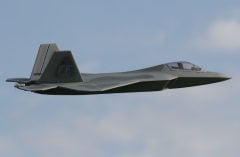 F-22 by Steve ShumateAfter a few years, we started getting requests for upgrades to the kits, things like clear canopies. So we reached out and had some custom forms made and they really add a lot to the models. One of the things that we think is pretty neat is that we had a graphic designer from Australia start putting together a bunch of decals for the different models. He agreed that we could ditribute them for free on our website as long as we kept them free. Sounded good to us. So we have now a full line of decals. It was really neat when we saw someone had used them to put on a custom motorcycle. Others have used them in different forums, like of all things, there is a G.I. Joe modeling forum out there that uses those decals a lot for putting together models. It's really crazy.
Do you have a lesson learned from starting an RC business?
Yes, we have lots of lessons. This won't be that popular to say but honestly the number one lesson we learned is that just because you have some people asking for a product, it doesn't mean it will sell. In some ways, its totally unpredictable. I can't tell you how many people have said they love the BD-5, and when we had it in the catalog, it wouldn't sell. Now maybe it was the design or maybe the price point wasn't right, but either way, it wasn't selling. So we spent a lot of time and energy into getting the model up and created, because we were sure it would sell. And then, nothing. Another one is that you have to keep your costs down. It's very easy as someone who is into the hobby to buy things and justify it because you are working on a new model or something. But really, if you approach it from a hobby perspective, good luck, because it's a very competitive space.
Is it a full time job for you?
Heck no. It's really a part time venture. We try to spend a few hours every day working on it. But if we plan right, the thing pretty much runs itself. The thing is, we have positioned 6mmFlyRC into a great little niche. With all the competition from China, with RTF (ready to fly) models, if we had tried to compete there, we would have failed. Where we set up our space is really where Parkjets is positioned. Right in that space where people still want to build. Not too long ago, if you wanted a plane you had to build it. So we planted our flag into that space of providing builders a little bit of a leg up, a little short cut. We would provide laser cut kits, very precisely cut, with some things like decals and clear canopies that the average modeler can't design or create themselves and see what happens. So here we are!
Why did you decide to sponsor Parkjets.com? I mean, it seems like the two are kind of at odds with each other. Parkjets offers no kits, but we provide over 100 free plans for download. Your site offers those kits from some of the very designs we give away.
Seems a little odd huh? Well actually, we figured the same people would be visiting Parkjets that might like to check out our kits. I mean, there is the whole idea that parkjets needed a sponsor and we truely believe that parkjets is good for the community. But more than that, there is a business component too. I mean, parkjets instantly became our biggest referrer for web traffic. That one banner provides a lot of people check out our site. The Steve Shumate designs continue to be popular on Parkjets and many of our kits are right from those designs, so it makes sense! I don't want to brush over the service that Parkjets provides. What, Parkjets gets something like 3 million page views a year right? So a lot of people use it. Heck, we have used it. Lots. And we figure a little thing we can do to give back to the community is the sponsorship. If it keeps the lights on at Parkjets, we are happy to do it.
That's great. We had no idea that Parkjets was your number one referrer. That's tremendous. Before we wrap up, do you guys have a secret to your longevity?
Secret? No not really. Frankly, we are really shocked that we are still selling kits. With all the change out there in RC, it doesn't seem possible that some of our designs are getting up there in age, but yet, they still sell. I think it has to do with the fact that people are always coming and going in the hobby. And it seems that in the continuum of RC, parkjet style jets seem to cross just about every hobbyist and it grabs them. With everyone's busy schedules, spending a little money to cut down a lot of time and frustration in the form of a kit makes a lot of sense. In terms of longevity, I guess the secret would be to just deliver what people expect. Most people out there are good people and if you just try to treat them right from a business perspective, they will return the favor 10 fold. Most of our customers come from referals from people right out in the field. In that way, we really get connected to the community. We have never even done any advertising and yet we have a steady stream of people coming to our site. Well, if you don't count Parkjets.com as advertising.
Anything else you want to mention?
No not really. I guess the thing is that we love Parkjets.com, keep up the good work. We love that you are adding new plans all the time and working hard to bring more information to the community. We are proud to be the sponsor of Parkjets and wish you continuted success!
Thanks a lot. There you have it. Be sure to visit 6mmFlyRC and check out their kits. They do provide a great product and great time saving way to still build but keep your trips to the hobby store down to a minimum. Thanks!
BARRACUDA UP CLOSE
We recently got a plan submitted to parkjets.com via E-mail that caught our attention, the EADS Barracuda. Being that it was all the way from Germany, of a German design, it was immediately pretty unique. Here is the meat of it:
Hi...a few weeks ago I got bored of flying RTF-models, so I decided to design and build my own aircraft. Parkjets.com helped me a lot in that process so thanks for that. I based my design on the EADS-Barracuda, a prototype drone aircraft. It ended up working better, than i thought it would, and the final model is an easy to build, unique looking EDF....Sabastian.
We decided to talk to the designer a little bit more about his design and got some excellent feedback. We think it will provide you with some insight and ideas about designing and flying. So here we go.
We recently got a plan submitted to parkjets.com via E-mail that caught our attention, the EADS Barracuda. Being that it was all the way from Germany, of a German design, it was immediately pretty unique. Here is the meat of it:
Hi...a few weeks ago I got bored of flying RTF-models, so I decided to design and build my own aircraft. Parkjets.com helped me a lot in that process so thanks for that. I based my design on the EADS-Barracuda, a prototype drone aircraft. It ended up working better, than i thought it would, and the final model is an easy to build, unique looking EDF....Sabastian.
We decided to talk to the designer a little bit more about his design and got some excellent feedback. We think it will provide you with some insight and ideas about designing and flying. So here we go.
Before we get going, can you tell us a little about yourself?
My name is Sebastian, I'm 29 years old, living in Germany and working as a helicopter pilot.
A helicopter pilot, wow. Okay, how long have you been in the RC flying hobby?
I've been into RC for a long time but just recently started with RC-flying. I own some RC-Helicopters, thinking i could control them easily, since i fly a real one for a living … but that wasn't the case. So I moved on to RC-planes. I'm still not an expert RC-pilot, but i can manage to keep a plane or a helicopter in the air now... mostly.
For the record, we can't fly helicopters very well either, real or RC!
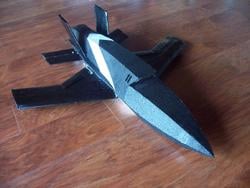 It's a very unique looking drone and the design you have created looks very simple to build. And its an EDF, something that a lot of RC pilots are getting into now. We have not seen the Barracuda modeled before and we think you really captured the look of the real aircraft. You mentioned to us that you started to get bored with out of the box solutions so you decided to design your own airplane. What made you decide on the Barracuda?
I just think the original Barracuda is a great design. It has the futuristic looks but was still simple enough for me to try to build it as my first scratch build.
What computer program did you use to design the EADS Barracuda because the build instructions and plans are very well documented.
I used solidworks for the 3d model. The instructions and plans were then made with Gimp and Acrobat Reader.
Your EADS Barracuda is an EDF, and our experience is pretty limited with EDF, just from a personal standpoint. We tried it a few years ago, but really thought the performance was not as good as a propeller. But today, things are getting cheaper and with a larger 70mm fan, EDF seems to be performing a lot better. Is EDF what you prefer?
The possibility of having a turbine-like drive at a tiny fraction of the cost convinced me of EDFs very early. You could probably get better efficiency using a pusher prop with the Barracuda, but that would not do the real jet justice, and I'm not even talking about the sound.
Any advise for people just getting into EDF?
They are way easier to use than you would think. You don't have to worry much about motor mounts, pitch etc. Just build a thrust tube and have fun. When first launching/throwing an EDF, you have to be aware of the lower static thrust. EDFs really shine once the plane reaches higher speeds, so throw a little harder.
You know, I'm glad you mentioned the learning curve, because with RC, there is so much information out there, and once a pilot has a good understanding of one type of power system, like a pusher prop, it can be a big leap of faith to try something like EDF. Especially because you already have money and time invested in another system. It's good to hear from someone that it's just not that hard.
Okay, tell us a little about your Barracuda. How long does it take to build?
Since it was my first build it took a little longer. I read a lot of the "Building" and "Getting Started" sections on parkjets.com … great help. I guess the pure build time to be around 20 hours for a beginner like me.
That's not a long build time at all, especially going from nothing to a fully flying machine. It looks like it involves some beveled cuts, any advise on how to achieve good beveled cuts?
I did build a hot wire cutter, however I noticed later that a utility knife and sanding paper works just as well if you take your time and mark the cutting line before. It is best to first cut out the part straight, and in a second step do the beveled cut.
What material did you use for your thrust tube?
I cut open a PET-Bottle, formed a cone to get the desired exhaust diameter and taped it back together.
That's a great solution, using a little material that you already have laying around. Nice tip. Does the Barracuda have any unusual flight characteristics?
It is very stable. It even tends to roll back to horizontal when letting go of the controls. As with any jet you have to maintain speed in turns to not risk a stall.
You built yours out of EPP foam, do you prefer EPP foam for your scratch builds?
It is my only build, so i can't compare EPP to other foam, but I'm more than happy with my choice since the Barracuda has bounced off the ground with no damage quite a times now.
Lastly, can we expect more designs in the future?
Yes, the building virus got me. My next project is already planned and I will start it as soon as I've finished the small version of the Barracuda.
That's exciting to hear, the Barracuda is already a highly downloaded plan on parkjets and I suspect your next design will be even better. I want to thank you for taking a few minutes to help fill in our readers on your design. We hope you allow us to post the plans to your future designs as well. Thanks again!
A lot of readers might be wondering how they can learn more about EDF systems and even learn a bit more about how they can learn how to design some parkjets on their own. Parkjets recently took a good look at a product out there on the market that is by far and away the best tool out there for beginners in RC flying. RCPowers has put out an excellent E-book series that answers just about all the questions you might have regarding EDF. There is an entire section on it. We liked the product so much, we became an affilliate for the product. We recommend you check it out, and if you buy it through Parkjets, we make a little money on it. We are confident you will find it well worth the money. So check it out. Just scroll to about the middle of the page or so, and check out all the different moduals.