
NEW PLAN - YAK-17 FEATHER

Robertus, the same guy who has several awesome plans on Parkjets, just sent us over a throwback jet just in time for December. The YAK-17 Feather is a sleek looking Russian flyer with great lines and great performace.
Better yet, with this model, Robertus gives all you EDF nuts out there a frame to throw a 70mm fan into and get to the park.
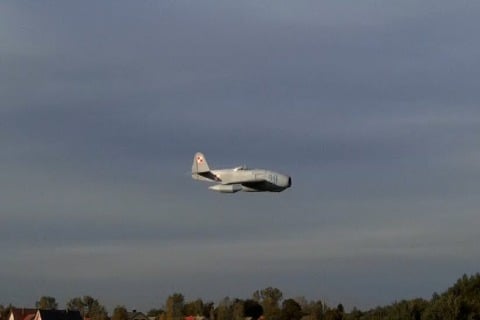
Robertus, the same guy who has several awesome plans on Parkjets, just sent us over a throwback jet just in time for December. The YAK-17 Feather is a sleek looking Russian flyer with great lines and great performace.
Better yet, with this model, Robertus gives all you EDF nuts out there a frame to throw a 70mm fan into and get to the park.
This is a great model for those of you out there getting tired of all the 5th generation fighters at all the flying fields. After all, half of going to the flying field is having something a little different, and the YAK-17 will get that job done.
Now that winter has settled in across the county, now is the perfect time to get some foam, crank up the music and get to building that next parkjet for your fleet in time for spring.
NEW PLAN - SAF-14
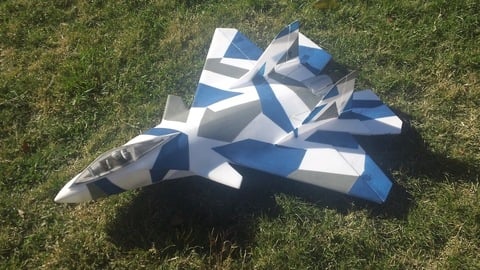
We just added in a new plan late last night, the SAF-14. Think of it as a combination of the F-35, SU-37, and bunch of originality. Better yet, this design comes from a new designer, Eduardo Flores. This model is built for EDF and based on the results, getting better than 1:1 weight to thrust ratio means it will perform like a good EDF should.
We just added in a new plan late last night, the SAF-14. Think of it as a combination of the F-35, SU-37, and bunch of originality. Better yet, this design comes from a new designer, Eduardo Flores. This model is built for EDF and based on the results, getting better than 1:1 weight to thrust ratio means it will perform like a good EDF should.
The plans are hand drawn, but easy to cut out, just print and cut. Designed for 3mm Depron foam, the SAF-14 looks to be a great addition to the parkjets line up.
This is also a gentle reminder, if you have designs you want posted, let us know, we will get them up for the world to enjoy!
NEW PLAN - EUROFIGHTER EDF
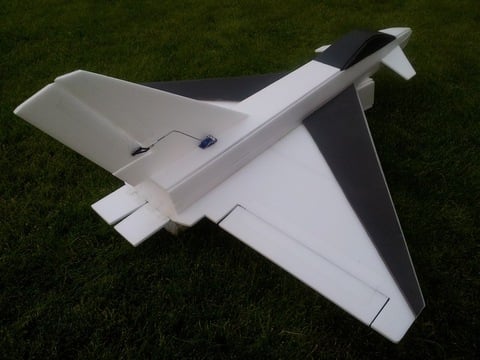
Just as the weekend was wrapping up, the designer of the Alpha Jet, F4F Wildcat and the F-15 shot us a quick E-mail with some new plans for the catalog. Now, we just added the great looking (and performing) Eurofighter EDF to the free plans catalog.
Just as the weekend was wrapping up, the designer of the Alpha Jet, F4F Wildcat and the F-15 shot us a quick E-mail with some new plans for the catalog. Now, we just added the great looking (and performing) Eurofighter EDF to the free plans catalog.
Mr. Rothwell designed this one around a 70mm EDF set up, but the design is large enough to accomadate a 90mm fan, so you have plenty of options. And like you might expect, the design has a few twists that make it totally unique, starting with the thrust vectoring tabs right in the back. Now, we are just guessing here, for the pilot that prefers a prop pusher set up, looks like with a little fire wall work, a prop would fit on this design as well.
The whole design takes two sheets of depron foam (6mm) and can be controlled with only two servos. Give this one a shot, the Eurofighter is an excellent park flyer platform and can take just about anything you can throw at it. You really can't go wrong.
BARRACUDA EDF VIDEO
For those of you that haven't had a chance to get on over to and check out the newest RC plan on Parkjets, here is the video of the EADS Barracuda. The plan file contains plans for a 68mm (or larger) EDF fan and also a mini version of the EADS Barracuda that is roughly 60% size and fits a 50mm EDF fan.
For those of you that haven't had a chance to get on over to and check out the newest RC plan on Parkjets, here is the video of the EADS Barracuda. The plan file contains plans for a 68mm (or larger) EDF fan and also a mini version of the EADS Barracuda that is roughly 60% size and fits a 50mm EDF fan.
For those of us watching the RC trends out there, we know that EDF is taking over the scene, but for those of us watching the avaition industry, we know that drones are the future. The Barracuda is a combination of both. An excellent RC airplane design of the real drone.
Check out the plans on our FREE PLANS section. You won't be disappointed. The plans are very well documented, with computer drawings of the plans as well as assembly instructions and set up guidelines. He built his out of EPP foam, but you could use just about any kind of foam including the popular Depron as well as simple foam board.
If you want to learn a bit more about the design, be sure to check out the interview with the designer as well.
PROP TO EDF CONVERSIONS
Probably the number one question we get in our inbox is whether we have documentation to convert some of our excellent RC "pusher" prop plans into EDF, or electric ducted fans power. Since we get the question all the time, we thought we would spend a little time discussing our feelings on the whole subject. If you are roaming around your local hobby shop, you will notice a lot of the boxed RC airplanes come set up for EDF. So it has a lot of RC builders wondering if its a right fit for them. Let's break this down a little.
First, several of our plans are excellent candidates for EDF conversions. The excellent F-14 and F-22 designed by Steve Shumate both will accommidate EDF fans. Both of these parkjets require dual fans, which works out great anyway. And don't forget, parkjets offers several models designed specifically for EDF. So check those out too. But with each of these conversions, the builder will have to make some adjustments to the original design like moving some pivot rods, perhaps enlarging some areas and of course working on ways to mount up the system inside the airframe. The result is pretty neat. They look and sound just like a mini version of the real thing. The F4D Skyray is also an excellent candidate for EDF conversion and in this case is pretty well documented with instuctions and pictures.
For the profile type RC parkjet, we have seen a very simple and very effective EDF conversion. It doesn't really offer the scale look, but offers an alternative to the mid mounted pusher prop that most of the designs have been built around. Below is an excellent video of the Tomas Hellberg F-22 with an EDF fan strapped to it. Most of the Tomas Hellberg plans would work well for this type of simple conversion.
You can see the builder just made a little modification and everything worked well. There are other videos of him flying the jet and it works quite well. The F-22 is a very versitile airframe.
So what do we think about conversions? Well, its complicated. We know there are some modelers out there who would rather not have an airplane than stick a prop on the back of a jet. It just seems so...wrong. We get that all the time. The EDF offers a lot of speed, no real torque and good speed. Some modelers are just looking for something different too. And we can certainly appreciate the attitude. Sometimes a builder wants to venture into a little different RC hobby.
However, for us, we like to stick to the prop. The 6 x 4 prop on one of these parkjets performs so well. The effeciency is through the roof, especially compared to EDF. Your battery will last longer, you need a smaller electronic speed control, the battery doesnt get as hot, and flight times are generally longer with the prop. Also, the thrust off the bat is so much better that a prop driven plane is often easier to hand launch. The reason is that the prop just grabs and moves so much more air in a single rotation that it leads to more bang for the Watt. EDF has to work so much harder than the prop to move the same amount of air. Of course, we all know that sometimes giving up a little gas mileage is worth the cool factor right? I mean, not everyone wants EFFECIENT when you can have a SLEEK right? So what about those RC pilots out there that want and must have and EDF driven airplane?
Well, luckily, EDF is getting better. And frankly, its darn near taking over the industry. At least from those models that come out of the box. Our recommendations is to stick to the bigger fans (68mm and up) and make sure you have a good wide airframe like the F-22, F-18 or even a delta type wingspan like the F4D.
And remember, when you toss that EDF for the first time, give it a heave, because that fan won't start to really push the air until it winds up and gets the plane moving through the air. Your thrust is limited at first.
You have heard our thoughts, now tell us what you think. EDF or Prop? There is no wrong answer as long as you are out there building RC airplanes from scratch or plans. You can't go wrong.
src="http://pagead2.googlesyndication.com/pagead/show_ads.js">
BARRACUDA UP CLOSE
We recently got a plan submitted to parkjets.com via E-mail that caught our attention, the EADS Barracuda. Being that it was all the way from Germany, of a German design, it was immediately pretty unique. Here is the meat of it:
Hi...a few weeks ago I got bored of flying RTF-models, so I decided to design and build my own aircraft. Parkjets.com helped me a lot in that process so thanks for that. I based my design on the EADS-Barracuda, a prototype drone aircraft. It ended up working better, than i thought it would, and the final model is an easy to build, unique looking EDF....Sabastian.
We decided to talk to the designer a little bit more about his design and got some excellent feedback. We think it will provide you with some insight and ideas about designing and flying. So here we go.
We recently got a plan submitted to parkjets.com via E-mail that caught our attention, the EADS Barracuda. Being that it was all the way from Germany, of a German design, it was immediately pretty unique. Here is the meat of it:
Hi...a few weeks ago I got bored of flying RTF-models, so I decided to design and build my own aircraft. Parkjets.com helped me a lot in that process so thanks for that. I based my design on the EADS-Barracuda, a prototype drone aircraft. It ended up working better, than i thought it would, and the final model is an easy to build, unique looking EDF....Sabastian.
We decided to talk to the designer a little bit more about his design and got some excellent feedback. We think it will provide you with some insight and ideas about designing and flying. So here we go.
Before we get going, can you tell us a little about yourself?
My name is Sebastian, I'm 29 years old, living in Germany and working as a helicopter pilot.
A helicopter pilot, wow. Okay, how long have you been in the RC flying hobby?
I've been into RC for a long time but just recently started with RC-flying. I own some RC-Helicopters, thinking i could control them easily, since i fly a real one for a living … but that wasn't the case. So I moved on to RC-planes. I'm still not an expert RC-pilot, but i can manage to keep a plane or a helicopter in the air now... mostly.
For the record, we can't fly helicopters very well either, real or RC!
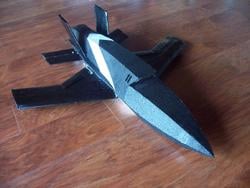 It's a very unique looking drone and the design you have created looks very simple to build. And its an EDF, something that a lot of RC pilots are getting into now. We have not seen the Barracuda modeled before and we think you really captured the look of the real aircraft. You mentioned to us that you started to get bored with out of the box solutions so you decided to design your own airplane. What made you decide on the Barracuda?
I just think the original Barracuda is a great design. It has the futuristic looks but was still simple enough for me to try to build it as my first scratch build.
What computer program did you use to design the EADS Barracuda because the build instructions and plans are very well documented.
I used solidworks for the 3d model. The instructions and plans were then made with Gimp and Acrobat Reader.
Your EADS Barracuda is an EDF, and our experience is pretty limited with EDF, just from a personal standpoint. We tried it a few years ago, but really thought the performance was not as good as a propeller. But today, things are getting cheaper and with a larger 70mm fan, EDF seems to be performing a lot better. Is EDF what you prefer?
The possibility of having a turbine-like drive at a tiny fraction of the cost convinced me of EDFs very early. You could probably get better efficiency using a pusher prop with the Barracuda, but that would not do the real jet justice, and I'm not even talking about the sound.
Any advise for people just getting into EDF?
They are way easier to use than you would think. You don't have to worry much about motor mounts, pitch etc. Just build a thrust tube and have fun. When first launching/throwing an EDF, you have to be aware of the lower static thrust. EDFs really shine once the plane reaches higher speeds, so throw a little harder.
You know, I'm glad you mentioned the learning curve, because with RC, there is so much information out there, and once a pilot has a good understanding of one type of power system, like a pusher prop, it can be a big leap of faith to try something like EDF. Especially because you already have money and time invested in another system. It's good to hear from someone that it's just not that hard.
Okay, tell us a little about your Barracuda. How long does it take to build?
Since it was my first build it took a little longer. I read a lot of the "Building" and "Getting Started" sections on parkjets.com … great help. I guess the pure build time to be around 20 hours for a beginner like me.
That's not a long build time at all, especially going from nothing to a fully flying machine. It looks like it involves some beveled cuts, any advise on how to achieve good beveled cuts?
I did build a hot wire cutter, however I noticed later that a utility knife and sanding paper works just as well if you take your time and mark the cutting line before. It is best to first cut out the part straight, and in a second step do the beveled cut.
What material did you use for your thrust tube?
I cut open a PET-Bottle, formed a cone to get the desired exhaust diameter and taped it back together.
That's a great solution, using a little material that you already have laying around. Nice tip. Does the Barracuda have any unusual flight characteristics?
It is very stable. It even tends to roll back to horizontal when letting go of the controls. As with any jet you have to maintain speed in turns to not risk a stall.
You built yours out of EPP foam, do you prefer EPP foam for your scratch builds?
It is my only build, so i can't compare EPP to other foam, but I'm more than happy with my choice since the Barracuda has bounced off the ground with no damage quite a times now.
Lastly, can we expect more designs in the future?
Yes, the building virus got me. My next project is already planned and I will start it as soon as I've finished the small version of the Barracuda.
That's exciting to hear, the Barracuda is already a highly downloaded plan on parkjets and I suspect your next design will be even better. I want to thank you for taking a few minutes to help fill in our readers on your design. We hope you allow us to post the plans to your future designs as well. Thanks again!
A lot of readers might be wondering how they can learn more about EDF systems and even learn a bit more about how they can learn how to design some parkjets on their own. Parkjets recently took a good look at a product out there on the market that is by far and away the best tool out there for beginners in RC flying. RCPowers has put out an excellent E-book series that answers just about all the questions you might have regarding EDF. There is an entire section on it. We liked the product so much, we became an affilliate for the product. We recommend you check it out, and if you buy it through Parkjets, we make a little money on it. We are confident you will find it well worth the money. So check it out. Just scroll to about the middle of the page or so, and check out all the different moduals.
FAN CALC 1.1
This is a great resource to help you figure out everything you nee to know about Radio Controlled EDF fan calculations.
NOTE: This program only works for PC's.
This is a great resource to help you figure out everything you nee to know about Radio Controlled EDF fan calculations.
NOTE: This program only works for PC's.
WHAT IS FSA | FOR EDF LOVERS
FSA (Fan Swept Area) is the area of the opening where the air goes through the fan. In other words, find the area of the entire face of the fan, the subract the area of the motor/spinner/hub, the result is the FSA.
Here's an example
WeMoTec Mini fan 480
Fan Shroud ID 2.715"
Motor tube OD 1.27"
Max Area 5.79 sq. in.
Motor tube area 1.27 sq. in.
Fan swept area 4.52 sq. in[U].
Tailcone diam. 100% 2.4"
Tailcone diam. 95% 2.28"
Tailcone diam. 90% 2.16"
The inlets may look quite small but if you measure and calculate the area you may find plenty of area. 100% of the FSA is the goal, a bit under you'll be ok, a bit larger is OK. You can go way above that and possibly improve static thrust, but too large and the scale looks begin to suffer (look at the huge nacelles on the GWS Me 262 and you'll see what I mean, they're way oversized) and there's increased drag at higher speeds because too much air is going in.
By Ed Waldrep
FSA (Fan Swept Area) is the area of the opening where the air goes through the fan. In other words, find the area of the entire face of the fan, the subract the area of the motor/spinner/hub, the result is the FSA.
Here's an example
WeMoTec Mini fan 480
Fan Shroud ID 2.715"
Motor tube OD 1.27"
Max Area 5.79 sq. in.
Motor tube area 1.27 sq. in.
Fan swept area 4.52 sq. in[U].
Tailcone diam. 100% 2.4"
Tailcone diam. 95% 2.28"
Tailcone diam. 90% 2.16"
The inlets may look quite small but if you measure and calculate the area you may find plenty of area. 100% of the FSA is the goal, a bit under you'll be ok, a bit larger is OK. You can go way above that and possibly improve static thrust, but too large and the scale looks begin to suffer (look at the huge nacelles on the GWS Me 262 and you'll see what I mean, they're way oversized) and there's increased drag at higher speeds because too much air is going in.
For exhaust aim for about 85 to 90 percent of the FSA.
Another thing to consider is the fan location. For most fighter type edfs, with the battery in the nose under a hatch, the fan needs to be placed with it's face toward the trailing edge of the wing. A fan access hatch on the bottom of the airplane usually looks better than one on the top.
Also, the battery mounting area up front should be made as long as possible to allow room for different sizes, lengths, and weights of batteries to be used. Some users will want to upgrade the power and making a small opening for only one size of battery that can't be moved makes upgrading difficult, a heavier battery would cause problems with balance.
Another factor is inlet ducting....it should be kept far apart until mid wing, then it should come together to meet at the fan. The reasoning is this will allow room between the ducting for a battery to slide farther back to achieve proper balance. A stock size battery may not need to go back that far, but with a power upgrade a heavier battery may be needed. However, you still need to make room for retracts on the outside, so there must be some room between the outside of the fuselage and the ducting, so back from the inlets in the front the ducting can head toward the center of the airplane but not at a really sharp angle, then once you get past the rearmost end of a battery the ducting can make another turn toward the center of the airplane and join in front of the fan. Avoiding sharp turns is important, make gradual turns if possible. With molded foam this is easily achievable.